Spot Landing
OVERVIEW
Spot Landing is a fun, simple, yet challenging event. The objective is to launch your model and have it land closest to a specified target. The model must land safely
There are three subsets of Spot Landing:
- Parachute Spot Landing. Model must use a parachute for recovery.
- Streamer Spot Landing. Model must use a streamer for recovery.
- Open Spot Landing. Any recovery device or method (except for radio control or similar) is allowed.
Open Spot Landing is the most commonly flown version.
For the full set of rules see The Sporting Code
SCORING
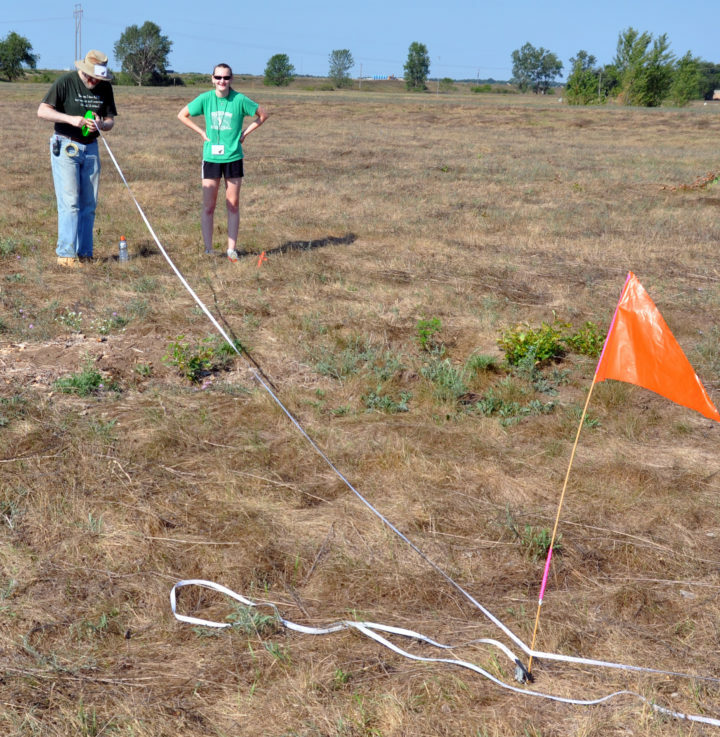
The score is the distance (in meters) from the nose cone of the model (after landing) to the target spot. Lowest score wins.
STRATEGY
The location of the target spot is set by the contest director prior to the start of the event. The spot might be placed close to the launch site, or it might be set farther away. Both options provide challenges.
The standard strategy is to fly a very simple model. The launch rod or tower is usually tilted (within 30 degrees of vertical) to send the rocket towards the target. The model typically has a small recovery device (streamer or parachute) to minimize drift due to wind. An alternate approach is to use featherweight recovery to further simplify the flight. “Flying Saucer” models are popular.
KITS
Just about any simple single stage model rocket will work well for this event.
NARAM 68 Beginner Tips
NARAM 68 will include Parachute Spot Landing. Any basic rocket will work with a parachute with at least a 15 cm diameter, so grab something from your range box and fly it, just make sure it's your first flight of the day!